
Macroeconomic data announcements, global trends and trading activity of foreign investors would guide momentum in the equity market this week, analysts said. Markets ended a five-week losing streak and gained nearly a per cent last week, helped by a sharp rebound on Friday. Last week, the BSE benchmark jumped 500.65 points or 0.77 per cent and the Nifty gained 169.5 points or 0.87 per cent.

Rupee is seen strengthening against the dollar.

ITC was the top loser in the Sensex pack, slipping over 3 per cent, followed by Maruti, Infosys, NTPC, HCL Tech and Tata Steel. NSE Nifty shed 63.20 points to close at 18,114.90.

Continuing its range-bound movement for the fourth session, the rupee today closed up by two paise at 59.25 ahead of industrial output and retail inflation data.

Bouts of month-end dollar demand from banks and importers hit the rupee

The Indian rupee on Tuesday ended marginally higher against the American currency at 61.41 amid volatile trading on the back of a higher dollar overseas.

The rupee came under pressure on demand from importers as the dollar strengthened overseas.

The Indian benchmark S&P BSE Sensex today eased by 14.59 points, or 0.05 per cent after touching its all-time intra-day peak.
At lower levels, a supportive buying in dollar forced rupee to depreciate since opening trade

Given the prevailing uncertainties, investors must maintain a 10-15 per cent allocation to gold in 2023.

Foreign investors have made a strong comeback to Indian equities with a net investment of Rs 22,766 crore in the first two weeks of December driven by expectations of rate cut by the US Federal Reserve. This revival follows significant outflows in the preceding months, with Foreign Portfolio Investors (FPIs) pulling out a net Rs 21,612 crore in November and a massive Rs 94,017 crore in October -- the worst monthly outflow on record.

The rupee which has been relatively stable over the last couple of months after having seen as much as 20 percent fall to a record low in late August has been boosted mainly by robust foreign fund inflows into the stock market.

The rupee on Thursday surged by 22 paise to close at a fresh three-week high of 61.75 against the US currency.

The rupee slipped 13 paise to 77.67 against the US dollar in early trade on Tuesday, weighed down by the surge in crude oil prices. At the interbank foreign exchange, the rupee opened at 77.65 against the American dollar, then lost ground to quote at 77.67, registering a fall of 13 paise from the last close. On Monday, the rupee settled at 77.54 against the US dollar.

The rupee is trading weak against the dollar in afternoon trade.

The RBI fixed the reference rate for the dollar at 63.8061 and for the euro at 69.6571.

The domestic currency has gained 9 paise or 0.13 per cent in two days.

On Thursday, the rupee jumped 50 paise to close at 62.67 against the Greenback on persistent selling of dollars by banks and hopes of capital inflows in view of a strong equity market.

Increased demand for the American unit from importers and banks, affecting the value of the rupee

Rupee gains for 4th day against dollar, up 17 paise on Fed stance.

In forward market, premium for dollar declined in view of mild receivings from exporters.

The rupee had lost 27 paise to close at more than 5-week low.
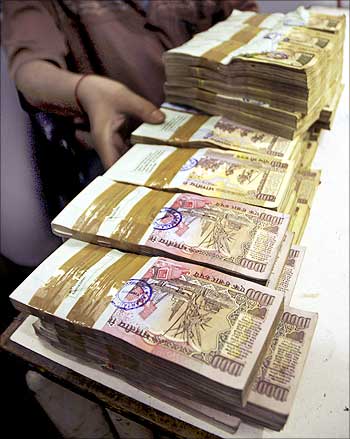
The domestic currency has gained by four paise or 0.06 per cent in two days.

'The bull market cycle ran for five years. It's the end of that cycle.' 'The next cycle is a down cycle, and in that down cycle, you will see the Sensex falling from their highs of around 68,000 to maybe 40,000-50,000 at the bottom of the cycle.'

The rupee recovered from more-than three months low of 63.15 in early trade on dollar selling by banks.

At the Interbank Foreign Exchange Market, the rupee resumed lower at 59.72 a dollar from the previous close of 59.67 and declined to a low of 59.88. It bounced back on dollar selling by exporters and some banks, touching a high of 59.30 before settling at 59.35, a rise of 0.54 per cent.

'Market corrections are a natural part of investing, so it's essential to remain focused on long-term financial goals.'

Earlier, the rupee resumed slightly lower at 61.70 per dollar as against Tuesday's close of 61.69 at the Interbank Foreign Exchange market.

The US stimulus programme has been credited with fuelling a global equities rally for most of the year.

Srinivas Bhogle and Purnendu Maji present Rediff.com's Most Valuable Player Index of IPL 2023 after Game 42.
The RBI interest rate decision, industrial production data for June and the ongoing quarterly earnings from corporates would largely drive the stock markets this week, analysts said. Other major factors such as global market trends, the movement of oil prices and the trading activity of foreign investors would also influence trading, they added. "The market will have an eye on the RBI Monetary Policy Committee (MPC) meeting, which will be announced on August 10, 2023. We are heading towards the last batch of Q2 earnings of key companies such as Adani Ports, Coal India, Hero MotoCorp, Hindalco and ONGC, among others, which will lead to stock-specific movement," said Pravesh Gour, senior technical analyst, Swastika Investmart Ltd.

The rupee ended weaker against the greenback on domestic worries.

The dollar's weakness against rivals overseas supported the rupee.

Most Asian currency and equity markets too suffered steep losses due to US rate hike fears.

The rupee on Tuesday weakened by 15 paise to close at 63.30 against the US currency

After a a steep fall last week, the rupee has closed slightly stronger against the dollar.
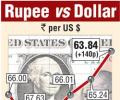
The rupee resumed higher at 64.40 a dollar from Friday's close of 65.24 and touched a low of 64.54 at the interbank foreign exchange market.

The dollar index was trading higher by 0.06 per cent against its major global rivals today.
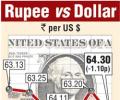
The local currency recovered some ground after the Reserve Bank of India (RBI) was said to have stepped in through state-run banks, helping the rupee to end at 64.30, a fall of 110 paise or 1.74 per cent.

Benchmark indices Sensex and Nifty declined in early trade on Wednesday due to selling in financials, oil and IT stocks amid weak global trends.
